Shark Chart!

After learning about Consonant Digraphs with short vowels at the end of the SOUND OUT WORDS section (II.c), and about Bossy R (III.b), it is time to learn about words that have BOTH! Words like…

SHARK CHART


I was inspired by Shark Week to put together a free set of activities that includes a worksheet, a word search, and a word sort. The words can be sorted two ways: by digraphs or by the Bossy R vowel. The SHARK CHART freebie is available to download at the Super Tutor Tools store at Teachers Pay Teachers. Also available is a free wordlist and set of bookmarks with consonant digraphs and vowel patterns.

PLAY the Shark Chart word search online.

Learn more about Word Sorts and get the free set of word sort games for the Phonics Pow Toolkit.

The ABCs of Games for Reading

ABCgames
Active, Board, & Card Games

When it comes to hands-on games to practice reading skills, a good mix includes Active games, Board games, and Card games. (For free online games for phonics, check out this Symbaloo.) This post contains ideas for each kind of hands-on game.

Alphabet

Phonemic Awareness

Short Vowels (CVC words)

Word Families

Blends

  • A. Blend target shoot. Write two different blends with dry erase marker on Solo plastic plates. Mix pictures for the two blends (from flyingintolearning below) to draw and throw a suction cup ball to hit the correct target.
  • B. Picture blend (flyingintolearning) match onto chart (thisreadingmama) or Great Green Grapes Blend Board Game (Super Tutor Tools)
  • C. Initial Blends go fish (Adrian Bruce)

Silent e

Bossy R

Consonant Digraphs

Diphthongs (vowel teams that make new sounds)

Vowel Teams that are often long

  • A. Pick & Toss – Cut 3 equal size holes in a large box or trifold presentation board. Label the holes AI, EA, & OA. Print Marshmallow Match from thebubblegumtree & cut out the word cards. Take turns drawing a card & tossing a ball or beanbag through the correct hole. 1st one to match & toss all three targets wins.
  • B. Make the Cake (Long A-Silent e & vowel teams), Nice Dice Vowel Teams, AI/AY Board game or the Phonics Patterns Board Game Set (Super Tutor Tools)
  • C. Vowel Pattern Yahtzee (Super Tutor Tools)

Sight Words

SHORT, LONG, or BOSSY R

After learning about Silent e and Bossy R, click on the wheel below to practice the patterns! Make three columns on the top of a page, with the headings: SHORT, LONG, or BOSSY R. Take turns spinning the wheel to choose a column, then roll dice to choose a word. See who can make the longest list of words in 5 minutes.


ShortLongBossyR

You can also download a worksheet. It can be printed on cardstock and the words cut apart for a word sort.

Games of all kinds make learning to read fun!
Word Sort Games

Cover

Word sorts are a tool for teaching reading skills that have been shown to be effective way for students to learn patterns in words. They are available through Gumroad. You can see the words included at Word Lists.

Online Word Sorts

I have continued to add to my collection of online word sorts made with Flippity. Download the Online Word Sort Index with links to them.

An online word family sort (with short vowels) from Read, Write, Think based on Flash works with the workaround at the End of Flash.

wordsortgames

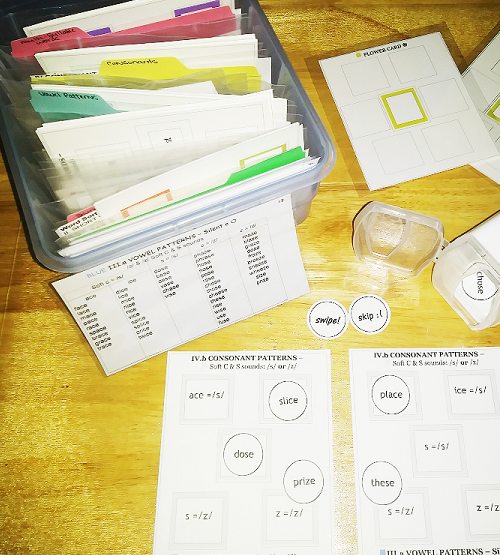
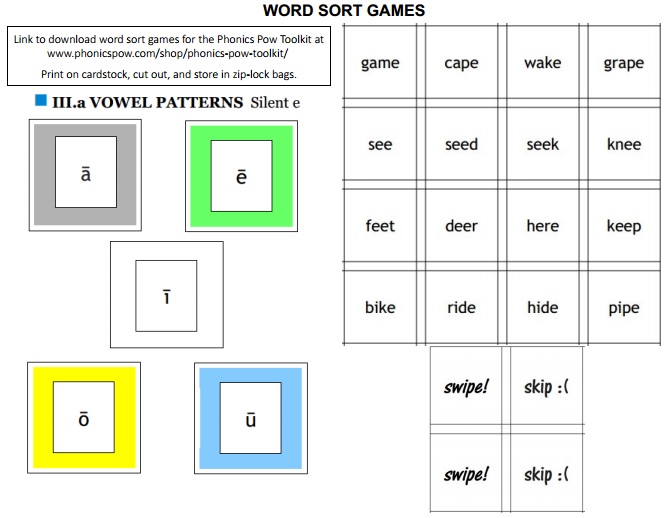
How to play: Choose the word cards for the phonics pattern to practice in sequence. Add cards that skip (the turn is skipped if drawn) or swipe (player can take a word card from the other player) in with the word cards. Each player has a phonogram card, and takes turns drawing a word card and placing it on the correct phonogram. For a quick game, the winner is the player who fills their the phonogram card with one word card of each pattern first. A longer game can be played by using all the word cards, with the winner being the player with the most word cards. POW!

WordSortGames

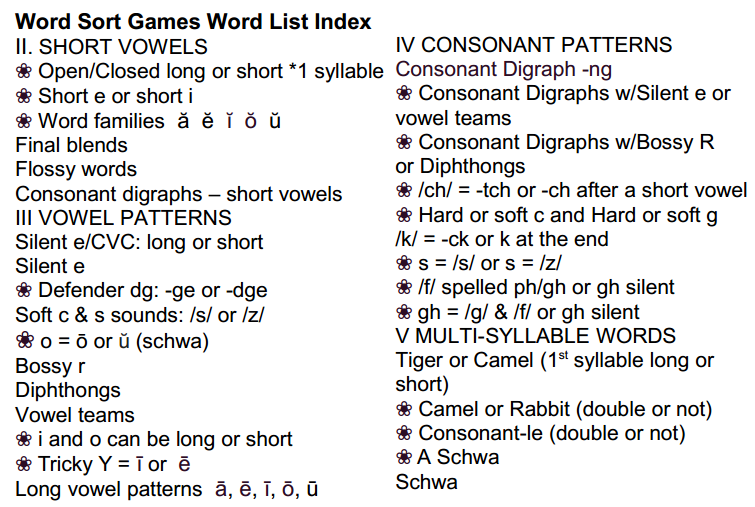
Many of the phonogram cards include color clues. ā is gray, ē is green, ī is white, ō is gold, ū is blue. Below is an index of all the sorts included.

CardsWordSortsIndex

How to set up and organize: Print on cardstock and punch pieces with 1″ circle punch or cut out. Place word sorts in small ziplock bags with labels, and keep in quart ziplock bags with expanding bottoms by sections, or in a Sterlite flip top box. Tabbed index cards are helpful for dividing sections. An empty Extra Refreshers gum container works great for mixing up and drawing the cards.

See the Word Sorts board at Pinterest, and check out the Phonics Pow Toolkit and visit Word Lists for a free download of the words included.

READ, just read

photo of girl reading book
Photo by Andrea Piacquadio on Pexels.com

Reading 20 minutes a day has been shown by research to have many benefits. Students who read 20 minutes a day from kindergarten through 6th grade are likely to score in the 90th percentile on standardized tests. Basically, reading makes you a smartie!

Smartie1

Below is a collection of great options for reading. Check your local library or a bookstore for books to target specific phonics skills, and explore the links below for books you can access anytime! Besides books and ebooks, your library may provide online access to resources like Bookflix from Scholastic – check with them.

This Symbaloo collection has links to many websites that provide books online. Some even include audio and/or video!

BEGINNING READERS

Decodable books contain only phonetic code that has been learned. Practice with words and sentences from Stickyball.net. Progressive Phonics has books that target phonics patterns that can be read online or printed. Reading Universe and  Freereading.net also have decodable passages.

Emergent readers contain pictures for support and repeating text. shala-books provides emergent and transitional readers with audio. Beginning reads from textproject.org contain many color pictures.

MORE ADVANCED READERS

Check Reading Comprehension at Mr Nussbaum (passages w/audio & comprehension check), myenglishpages.com and K5 Learning (passages w/comprehension)

Classic Ebooks: Bygosh.com has ebooks for children, and Project Gutenberg has a children’s bookshelf with picture books and children’s literature. More at the Library of Congress website, Read.govLoyalbooks.com has free classic ebooks and audiobooks, and free classic ebooks may be found at Manybooks.net, Standard Ebooks, and Planetebook.

Screen and Page: This list of movies based on books at IMDB.com is great for ideas. Also see the Pinterest board of Screen Reads for Kids and Teens. The Kids Screen Reads list includes links to free ebooks when available.

Get more ideas with Reading Book Lists at www.k-12readinglist.com.

With so many options, there is no better time to read than now!

10 Steps to Reading

Learn skills for reading with the following ideas. These tips include some of my favorite free online resources.Reading101

Download the 10 Steps to Reading (pdf)

1. Learn letter names  & sounds, and practice hearing and manipulating sounds; Phonemic awareness.

2. Sound out words with short vowels and CVC words (Consonant-Vowel-Consonant), practice with word families, then continue with consonant blends.

3. Learn phonics patterns in a sensible sequence as the student is ready. Try the phonics presentations at ReadingBear.org and watch fun videos that cover many phonics patterns with Kids vs Phonics from RedCatReading.

4. Practice patterns with picture and word sorts.

5. Play games that encourage literacy. Hands on games include traditional games like Boggle and Bananagrams, as well as many free printable games that can be found through links on specific phonics skills. Free online games are also available at this Symbaloo. Some online games require flash, which is no longer supported after 12/31/2020. Learn more at The End of Flash.

6. Read books to practice the patterns. The books from Progressive Phonics are free, fun, and practice the phonics patterns. They can be printed or read online.

7. Learn sight words. Many high frequency words are not decodable with phonics guidelines.

8. Encourage reading 20 minutes a day. Children who do this from Kindergarten through 6th grade score 90% better than their peers on tests. Check out more Benefits of reading.

9. Use your library. Attend storytimes, participate in summer reading programs, check out books & online resources. Choose fun books at the right level.

10. Read “Phonics from A to Z” by Wiley Blevins (online at issuu) and learn literacy terms.

Credits: Some artwork copyrighted by Mark A Hicks, illustrator, www.MARKiX.net. Used with permission. Sources for other graphics at PinterestPattern charts from boostforreaders

Learn more at Reading Basics from ReadingRockets.org. They have a Get Ready to Read screening tool too.

Sequence for teaching reading

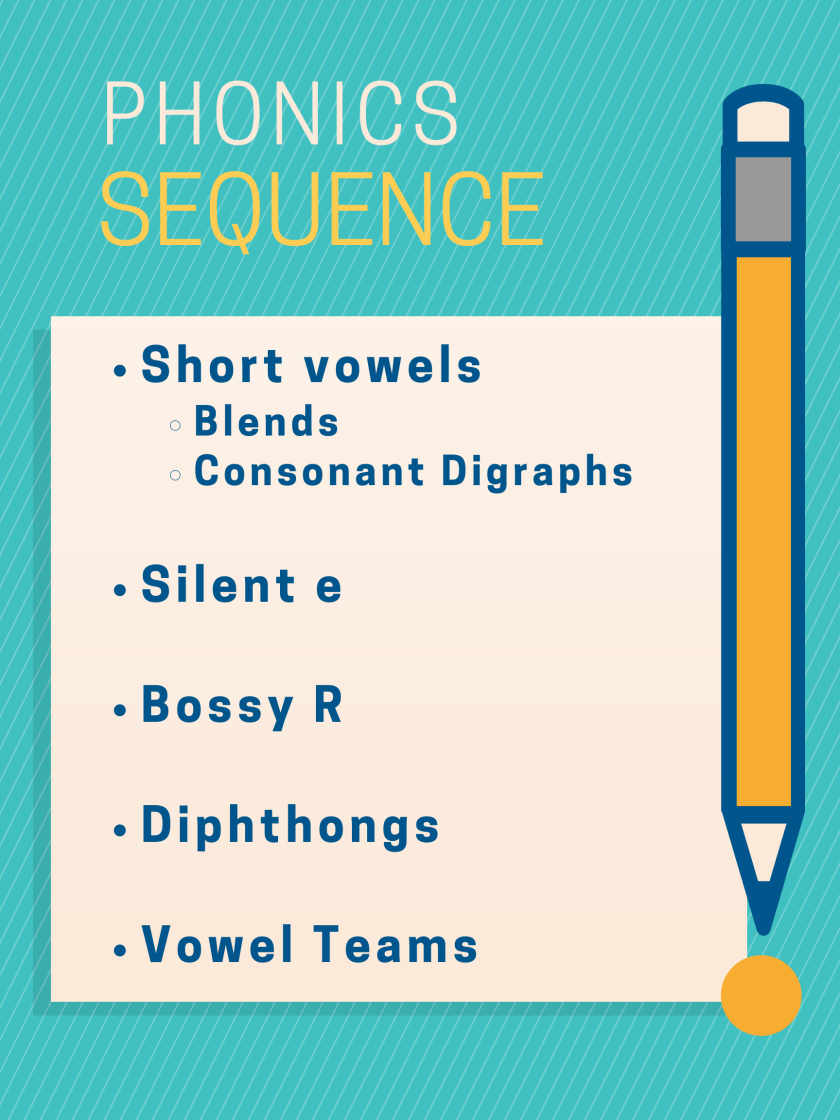
PhonicsSequence

The sequence followed by different methods of teaching reading can vary. The Phonics Pow Toolkit is designed to help teachers teach, and students learn with a sensible sequence that builds on skills as they are learned. It is organized in five sections, with most sections having three parts (except the vowel pattern section, which has six). Color coding often provides clues, like the color RED (a CVC word with a short vowel) for the SOUND OUT WORDS section. As much as possible, one syllable words that include only patterns that have been learned are used until the final section. Strategies provide clues but there are many exceptions to learn.

Closed syllables often have a short vowel (with some exceptions). Open syllables have a long vowel sound, and are most often found in words with more than one syllable. However, there are some one syllable words that are open, like: he, me, we, no, go, and so. These are sight words that are frequently seen in written text, so introducing open and closed syllables with one syllable words is a good plan.

Blends are introduced next, with words that have a short vowel.

Consonant patterns are placed together in one section for convenience. Digraphs are a pair of letters that represent one sound. Consonant digraphs make new sounds, and may be introduced with words that have a short vowel at the end of the SOUND OUT WORDS section. Many words with consonant digraphs have advanced vowel patterns that have not been introduced yet, so those are covered as patterns are learned.

The schwa sound is usually a quick and weak “uh” that can be made by any vowel. It is often found in words with more than one syllable. However, there are a few one syllable words with the schwa sound like: of, from, and was. At the end of the silent e section, more is learned with words like “love” and “gloves,” which make the schwa sound instead of being long. The idea of schwa is introduced as a way that vowels can vary.

Learning Vowel Patterns begins with Silent e, then Bossy R, followed by Diphthongs and Vowel Teams. Vowel digraphs or combinations are separated into those that often make a long vowel sound (vowel teams) and those that make mostly new sounds (diphthongs). When diphthongs are introduced first, many of the remaining combinations make a long vowel sound. However, this is not always reliable, and there are many exceptions to learn about, so they are the last vowel patterns to learn. The final section includes Consonant-le syllables and more work with multi-syllable words.

I. GET READY

II. SOUND OUT WORDS

III. VOWEL PATTERNS

a. i & o can be long when followed by 2 consonants (find & lift the lost gold)
b. Tricky y, EA/EA, IE/IE, OW/OW
c. EI/EI, EY/EY, UI/UI, EI/IE, OUGH, Bossy R variations (Silent e vs Bossy R, Schwa, EAR, AIR)

IV. CONSONANT PATTERNS

V. MULTI-SYLLABLE WORDS

Phonics instruction that is systematic (presented in a logical sequence) and explicit (directly taught) has been shown by research to be beneficial in teaching reading. Learn more about the Phonics Pow Toolkit and how to be a super reading teacher.

Find many Super Tutor Tools and Resources for teaching reading.

The 44 Sounds of English

One of the reasons that English is challenging to learn to read is that 26 letters make 44 sounds, called phonemes! This means that sometimes letters combine to make sounds. Phonograms are the written representation of a sound, also known as graphemes, and there are 72 phonograms.

WATCH What is a Phonogram? from Raising Robust Readers, and 72 Phonograms from printandpractice.com, a website that also provides printable flashcards. Another video from RRFTS 44 Phonemes from (5:29). Watch more videos at this Phonics Pow Youtube playlist.

LISTEN to phonograms online at the Oxford Owl, or an online chart with audio & video from thelogicofenglish. There is a free Phonogram app from allaboutlearningpress.

The Phonogram Chart below is available free from the Super Tutor Tools store at Teachers Pay Teachers. (also find more Pattern Charts)

PhonogramChart

There are lots of exceptions, so the “rules” are more like guidelines. With a few exceptions, the 21 consonants make one sound, so an alphabet chart represents a lot of them. Things begin to get interesting with the vowels, which can be short, or long, or make new sounds.

The first focus in learning to read is on the short vowels. Long vowels say the letter name, while short vowels say the sound. Short vowels are found in words with closed syllables, like those formed by a consonant-vowel-consonant known as CVC words (as in cat and dog).

Next, learn about silent e; an e at the end of a word (except two e’s are like twins that often like to stick together) changes the vowel to the long sound.

Continue with Bossy R: an r after each vowel changes the sound it makes.

Now we are beginning to get into advanced phonics code.

Two letters can work together. Sometimes they make new sounds, like the consonant digraphs CH, SH, TH, WH & NG. (PH can make the /f/ sound)

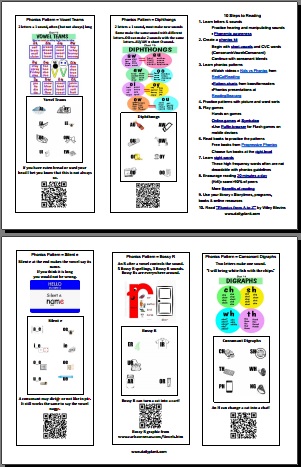
Vowels can also work together; some can make new sounds, and some (often) make a long vowel sound. Diphthongs are (mostly) vowels that work together to make (mostly) new sounds.

One sound can be represented in different ways. Many of the diphthongs are like this: OI & OY make the same sound, as do OU & OW (although OW can also make a long O sound), and OU has many variations. AU & AW make the same sound as a short O. See many different ways long vowels can be represented at Long Vowel Patterns.

One letter or set of letters can make more than one sound. OO (boot) & OO (foot) is just one example!

Once the diphthong patterns are learned, many of the remaining vowel teams are often (but not always) long.

2 letters that work together, some vowels work as a team. 2 letters can work together, and the first one likes to speak. They might be long (except the diphthongs!), here are some you may have seen.

This part of the chart includes Tricky Y, which can sometimes be a vowel that makes the long I sound, and sometimes the long E sound. Once again, one sound can be represented in different ways.

When all of these phonics patterns are put together, the result is a one page vowel chart that represents many of the vowel sounds.

Download the Grocery Store Vowel Patterns Chart for free at the Super Tutor Tools store at Teachers Pay Teachers. A chart with the many possibilities is available at dyslexia-reading-well.com, with a printable pdf here. Another resource with the 44 sounds ( pdf) is available at uldforparents.com.

Reading Lesson Plan

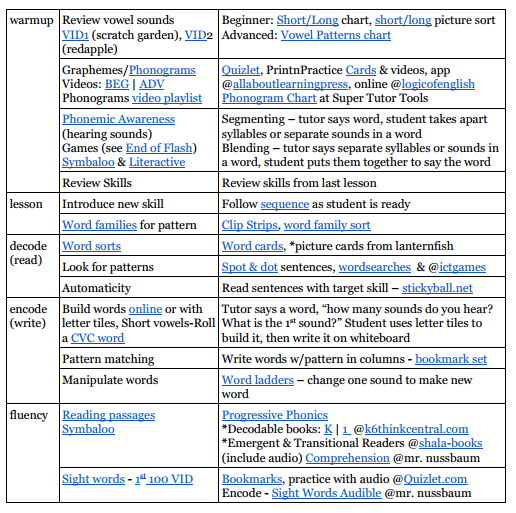
TutorSessions

Download Reading Tutor Plan pdf

This plan to follow for tutoring students learning to read was inspired by Phonics Intervention from Sarah’s First Grade Snippets. The amount of time spent on different activities varies depending on the needs of the student. The assessments at the end of this post help know where to start. These activities can begin once letter names and sounds have been learned.

WARM UP

Review vowel sounds: Beginners-short or long vowel chart, More Advanced-the Vowel Patterns grocery store chart. Watch videos at the Short or Long Wakelet.

Review phonograms with Quizlet flashcards and videos at the Phonograms Wakelet, and the Phonogram playlist at the Phonics Pow Youtube channel.

Phonemic Awareness practice (using voice only)

      • Segmenting: tutor says word, student takes apart syllables or separate sounds in a word
      • Blending: tutor says separate syllables or sounds in a word, student puts them together to say the word.
      • Play online games for Phonemic Awareness at the post on Phonological and Phonemic Awareness.

REVIEW – Review skills from last lesson

LESSON – Introduce a new skill, following sequence as the student is ready. Start with word families for the pattern: free printable clip strips and pdf of word families with phonics patterns. See also Word Lists.

DECODE (read)

Word Sorts

Look for patterns with Spot and dot sentences at the Super Tutor Tools store at Teachers Pay Teachers. Try a word search puzzle or wordsearches at ictgames.

Automaticity: Read sentences with the target skill at stickyball.net

ENCODE (put letter sounds into writing)

Build words with a magnetic whiteboard and letters, or online resources. UFLI has a printable word work mat and online blending board, or use virtual magnetic letters from room recess or big brown bear. More options at the Letter Tiles Pinterest Board. Say a word, then ask “how many sounds do you hear? What is the first sound? Etc.” The student uses letter tiles to build it, then writes it.

Manipulate words – Word Building and Substitution-change one sound at a time to make new words. Find more at the word families and ladders Pinterest board.

Pattern matching – Write words with the patterns in columns under the correct pattern – Bookmark freebie.

FLUENCY

Read sentences with different phonics patterns from Stickyball.net. Practice reading with a passage from Progressive Phonics. Find more options at Read, Just Read.

Review sight words with Quizlet flashcards and free bookmarks from Super Tutor Tools. Encode sight words with Sight Words Audible from Mr. Nussbaum.

ASSESSMENTS:

Download assessments for letter names and sounds skills and phonemic awareness skills at heggerty.org. (enter email to receive)

See more at the Assessment Pinterest Board

Symbaloo of Literacy Tools

Add fun by practicing with games in the Phonics Pow Toolkit!

Phonics Terms

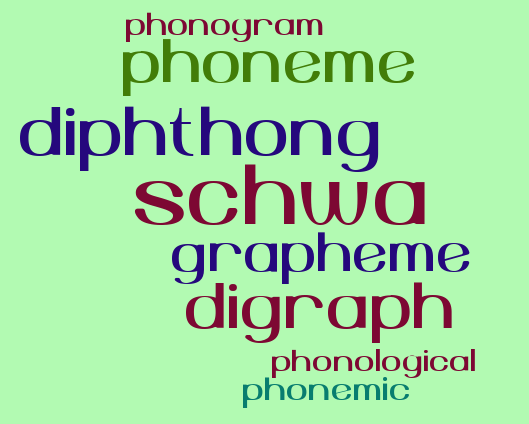
PhonicsTerms

The language of phonics can be a little overwhelming. Here are the definitions of some important words to know to teach reading.

Phonics Terms

  • Digraph-a pair of letters representing a single speech sound (consonant digraphs, and vowel digraphs or vowel teams)
  • diphthong-two vowels combine to make one sound with mouth positions that change.
  • grapheme–the written representation of a phoneme
  • phoneme-the individual sounds that make up a word
  • phonics–the relationship between letters and sounds
  • phonogram – a symbol representing a speech sound
  • schwa–a lightly pronounced “uh” vowel sound that can be represented by any vowel
  • syllable–a unit of speech generally containing only one vowel sound

There are more definitions of Literacy Terms at atozphonics.com and quizlet.com

Fun Online Phonics Games

Learning to read isn’t an easy skill to master, and it takes time and practice. But sometimes practicing the skills needed for reading can be fun! Many websites provide free online games that make learning more fun. However, it is not always easy to find games that target a specific phonics skill. The games in … Continue reading “Fun Online Phonics Games”

Learning to read isn’t an easy skill to master, and it takes time and practice. But sometimes practicing the skills needed for reading can be fun! Many websites provide free online games that make learning more fun. However, it is not always easy to find games that target a specific phonics skill. The games in this post are targeted to practice the skills needed to understand the 44 sounds of the English language.

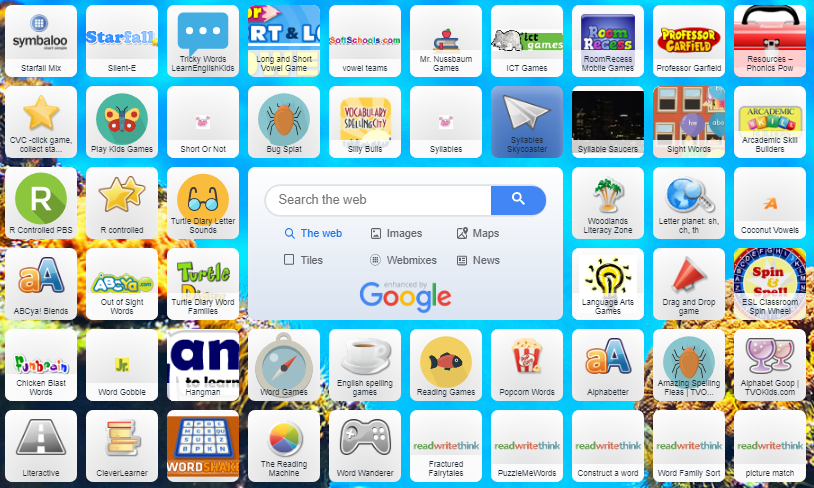
Symbaloo
Symbaloo of phonics games at www.symbaloo.com/mix/phonicsgames7

Some online games require flash, which is no longer supported after 12/31/2020. Learn more at The End of Flash.  Some more mobile friendly games are collected at this Symbaloo. More online games at these Symbaloo collections. See also Videos and Games by Topics

I. GET READY

Phonological & Phonemic Awareness: Symbaloo collection for Phonemic Awareness

Letter names and soundsAlphabet Games at Wakelet

II. SOUND OUT WORDS

Short vowels and Word families

Blends

III. VOWEL PATTERNS

Silent e

Bossy R

Diphthongs – vowel combinations that make (mostly) new sounds

  • galacticphonics.com (Flash) Symbaloo collection

Vowel Teams that are often long

Vowels that vary: Wild Old Words at wordwall.net

Short or Long Vowels

IV. CONSONANT PATTERNS

Consonant Digraphs

Consonants that vary

V. MULTI-SYLLABLE WORDS

Open & Closed Syllables

Consonant -le: consonant-le at wordwall.net

Schwa: Schwa words at wordwall.net, Online Quiz at purposegames

Word Search Puzzles

Check out this Pinterest board collection of videos and games by topic.

websites in alphabetical order:

abcya.com – a teacher-created website that provides fun and educational games for kids. Pre-K through 5th grade, and includes games for learning letters (also numbers and more) It is free for use on pcs (ads) and can be obtained for mobile or tablet use with a subscription.

arcademics.com – arcademic skill builders are free online educational video games that offer a powerful approach to learning basic math, language arts, vocabulary and thinking skills. These are highly engaging and some are multi-player. Apps are available for both Android and iOS.

www.education.com – has many resources on a variety of topics. To access worksheets and more resources there is a subscription fee, but there are many games available for free (with a sign-in) for learning reading skills. AlphabetSyllable CountingShort vowel sort, Short Vowel Sort, Long/Short sortBlends, and Silent E +more. Also Digraphs Hopper & Digraphs Photoshoot, Sight Words Balloon Pop and more, Compound Word Fish, Interactive Stories.

eslphonicsworld.com – many free online phonics games

ezschool.com – some free online phonics games

Funfonix.com – free online games (and worksheets) for phonics.

GalacticPhonics

Galactic Phonics (Flash) – free resources created by teachers. It can be difficult to find games to practice diphthongs, this site has a good collection plus more. Find them all at Symbaloo.

Ictgames.com – free online games for phonics, mobile friendly

Kizphonics – an online phonics program which provides a few games on each level free, access beyond that requires a membership.

Learn English Kids -from the British Council

Learninggamesforkids.com – free online learning games

Making English Fun – many online games, apps are available.

Mr Nussbaum – has lots of mobile friendly literacy games and interactive resources. Build words with Word Maker and blend sounds with Sound Garden.  (Two Letters with both digraphs & blends available with upgrade) See a Phonics Focus video at the post about Phonics Fav Mr. Nussbaum.

pbskids.org – a website from the Public Broadcasting System which is aimed at preschool kids.

phonics bloom – many games that work on pc and mobile devices, some free and more with subscription

readwithphonics.com – free for schools, libraries, & educational organizations with 10 or more students. Parents can pay for access, and there is an app available.

readwritethink.org – provides free materials including some games (Flash)

RoomRecess.com has lots of reading games. Many are available for both pc & mobile.

roythezebra.com – some content free, more with registration

sadlier-oxford.com – an educational publisher of books and materials for grades PreK to 12+. Some games are available on pc only at SadlierConnect

Skillswise – provided by the British Broadcasting Corporation, this website includes a section of English Games. There is lots more about reading, writing, and math for higher levels.

softschools.com – provides many resources for free, including Phonics plus other resources. A premium subscription is available that removes ads and lets teachers set up student account to track progress.

splashlearn.com – tons of phonics games, free with sign-up, apps available.

starfall.com – provides some free content on phonics aimed at early grade levels, with expanded content available for a subscription. Starfall classic, free app is available.

teach your monster to read – free on PC with sign-up. App is available.

turtlediary.com – provides many resources for free on PC only. Premium subscription removes ads and allows mobile play. app is available

wordwall.net – teacher made resources, whack-a-mole, random wheel, and more! A similar site is tinytap.com.

yourchildlearns.com – some free online games for reading.

Check out Wakelet collections of online games (and videos) by phonics topics at Pinterest.

There are also many hands on games! Wordplay Games includes both online and hands on games, and more hands-on games are at the ABCs of Games for Reading and at individual posts about phonics patterns by sequence.

Too many people struggle with learning to read. Low literacy levels often lead to limited opportunities for employment, according to literacy statistics at Phonics Facts. Make a difference by sharing the resources at Phonics Pow to help others teach reading.