
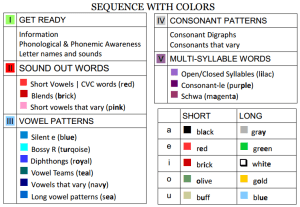
The sequence followed by different methods of teaching reading can vary. The Phonics Pow Toolkit is designed to help teachers teach, and students learn with a sensible sequence that builds on skills as they are learned. It is organized in five sections, with most sections having three parts (except the vowel pattern section, which has six). Color coding often provides clues, like the color RED (a CVC word with a short vowel) for the SOUND OUT WORDS section. As much as possible, one syllable words that include only patterns that have been learned are used until the final section. Strategies provide clues but there are many exceptions.
Closed syllables often have a short vowel (with some exceptions). Open syllables have a long vowel sound, and are most often found in words with more than one syllable. However, there are some one syllable words that are open, like: he, me, we, no, go, and so. These are sight words that are frequently seen in written text, so introducing open and closed syllables with one syllable words is a good plan.
Blends are introduced next, with words that have a short vowel.
Consonant patterns are placed together in one section for convenience. Digraphs are a pair of letters that represent one sound. Consonant digraphs make new sounds, and may be introduced with words that have a short vowel at the end of the SOUND OUT WORDS section. Many words with consonant digraphs have advanced vowel patterns that have not been introduced yet, so those are covered as patterns are learned.
The schwa sound is a quick and weak sound (often “uh”) that can be made by any vowel. It is frequently found in words with more than one syllable. However, there are a few one syllable words with the schwa sound like: of, from, and was. At the end of the silent e section, more is learned with words like “love” and “gloves,” which make the schwa sound instead of being long. The idea of schwa is introduced as a way that vowels can vary.
Learning Vowel Patterns begins with Silent e, then Bossy R, followed by Diphthongs and Vowel Teams. Vowel digraphs or combinations are separated into those that often make a long vowel sound (vowel teams) and those that make mostly new sounds (diphthongs). When diphthongs are introduced first, many of the remaining combinations make a long vowel sound. However, this is not always reliable, and there are many exceptions to learn about, so they are the last vowel patterns to learn. The final section includes Consonant-le syllables and more work with multi-syllable words.
I. GET READY
- Information – see Charts at Tutor Tools
- Phonological & Phonemic Awareness
- Letter names and sounds – Voiced & unvoiced consonants
II. SOUND OUT WORDS
- Short vowels and Word families
- Blends (with short vowels) -Welded A Skunk Drank a Pink Drink
- Short vowel variations – introduce Flossy words, a can say ŏ, Consonant Digraphs (two letters make one sound): -ck = /k/ after short vowels, and others with short vowels. Schwa in one syllable words: The sled was a lot of fun, and some with the letter o: My son won a ton of money a month from the lottery. i and o can be long when followed by 2 consonants is covered in the Vowels that Vary section III.e.a.
III. VOWEL PATTERNS
- Silent e – follow with Silent e variations: g before e will often soft /j/ be, c before e will often soft /s/ be (-ace & -ice word families) and s =/z/ (rose in a vase), words with a schwa sound (some love gloves)
- Bossy R – Bossy R variations covered in Vowels that vary
- Diphthongs – vowel combinations that make (mostly) new sounds
- Vowel Teams that are often long
- Vowels that vary
a. i & o can be long when followed by 2 consonants (find & lift the lost gold)
b. Tricky y, EA/EA, IE/IE, OW/OW
c. EI/EI, EY/EY, UI/UI, EI/IE, OUGH, Bossy R variations (Silent e vs Bossy R, Schwa, EAR, AIR)
IV. CONSONANT PATTERNS
- Consonant Digraphs – tch ending Catch the Pitch
- Hard or Soft C and G
- More consonants that vary – /k/ sound at the beginning of words, sounds of s, sound of f, GH A ghost with a slight cough gave a great fright
V. MULTI-SYLLABLE WORDS
Phonics instruction that is systematic (presented in a logical sequence) and explicit (directly taught) has been shown by research to be beneficial in teaching reading. Learn more about the Phonics Pow Toolkit and how to be a super reading teacher.
Find many Super Tutor Tools and Resources for teaching reading.
 Phonics Pow