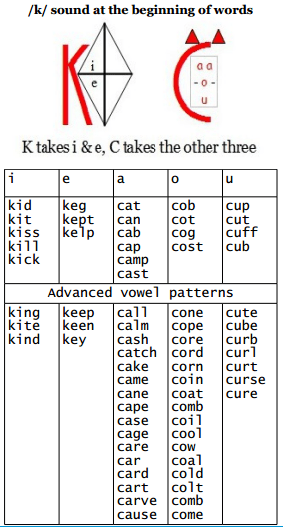
The /k/ sound at the beginning of words can be spelled with a c or a k. This is one of the consonants that can vary. This can be introduced with words that have a short vowel, adding more advanced vowel patterns as they are learned.
K takes i and e, and C takes the other three.
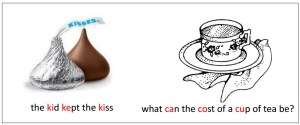
Some words with short vowels can begin with the /k/ sound. The kid kept the kiss. What can the cost of a cup of tea be?
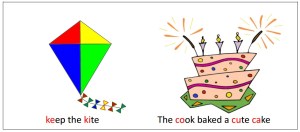
Some words with more advanced vowel patterns can begin with the /k/ sound. Keep the kite. The cook baked a cute cake.
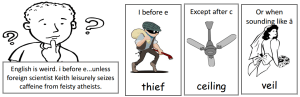
You may have heard this saying: i before e, except after c, and when sounding like a, as in neighbor and weigh. This is a guideline where there are quite a few exceptions: i before e, unless foreign scientist Keith leisurely seizes caffeine from feisty atheists.
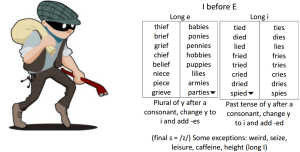
Generally speaking, i before e (as in thief and tried)
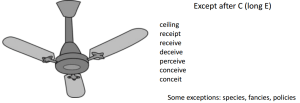
except after c (as in deceive)
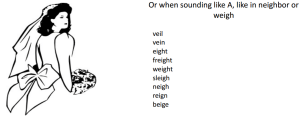
or when sounding like a, as in neighbor or weigh (and eight)
This is just one of the ways that vowels can vary. Practice with the I before E is Weird set of worksheets, available at the Super Tutor Tools store at Teachers Pay Teachers.
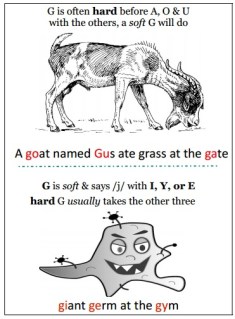
G is often hard before A, O & U. With the others, a soft G will often do.
(But this is not always true, which you know if you get a gift given to you!)
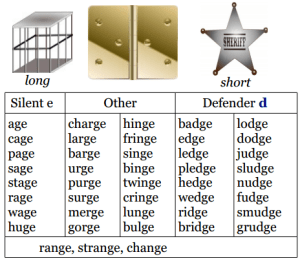
G before e will often soft be. Words that end in -ge or -dge have the soft G sound of /j/. Defender d can stop the vowel from being long in some Silent e words.
Sight words with:
Hard c /k/: can, came, car, cut
Soft c /s/: face, place, space, sentence
Hard g: go, got, big, give
Soft g /j/: large, page, change
Keyword sentence: I got a large change when I came to this place.
There are some words with short vowels that have a hard or soft c and g, but many more have advanced vowel patterns. Because of this, hard or soft c and g (IV.b) are introduced after learning about Defender d at the end of the Silent e section in the Phonics Pow Toolkit. (III.a) Download worksheets or the free anchor charts with word lists for hard or soft c and g at the Super Tutor Tools store at Teachers Pay Teachers. The Consonant Variations soccer sort game includes hard or soft c and g, plus the ending sound of /k/.
WATCH videos and PLAY games about hard or soft C and G at the Wakelet tutorial on hard or soft C and G.
Learn how to get the free word sort games that include hard or soft c and g. Game boards for hard or soft c and g are part of the Phonics Pow Toolkit.
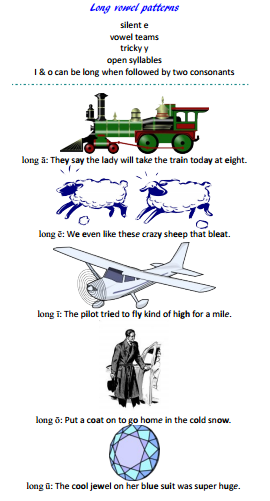
IGH is a trigraph – one sound is made with three letters. The gh is silent and the i is long. The sound of IGH is included with vowel teams in the Phonics Pow Toolkit, as the other vowels have teams that make the long sound, but i only has the trigraph IGH. Learn more about the vowel trigraphs AIR and EAR at Bossy R variations. WATCH videos on igh from Little Learners and Kids vs. Phonics, and try a long i wordsearch.
IGH is included in the Vowel Teams section of the Phonics Pow Toolkit. III.4
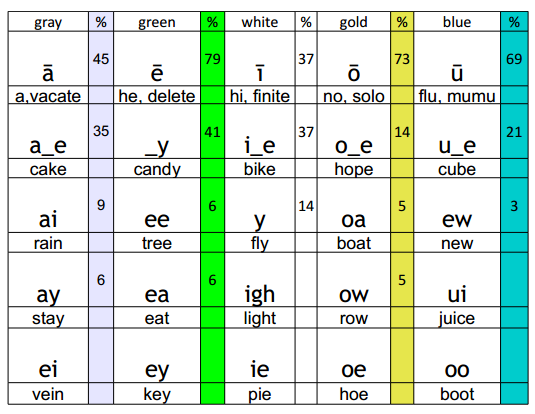
ā – ai & ay
ē – ea & ee
ī – igh
ō – oa & ow
ū – ui & ew
Can you identify all the long vowel patterns in the sentences below?
The phonogram OUGH is one of the toughest in the English language, with at least six different pronunciations.
Although (long o) I ate when I was through (ew) ploughing (ow) the garden, the meat I bought (short o) was so tough (short u) it made me cough (short o).
In some words:
ough = ow (gh is silent): plough, bough, drought.
ough = ō (gh is silent): dough, although, thorough.
Practice OUGH words at Quizlet, and highlight the OUGH words in the sentences at BBC Bitesize. LISTEN at pronunciationcoach.blog, and WATCH the video below from the “I Love Lucy” show.
When we learn about diphthongs, the main sound of OU is OW, but it can vary, as seen in these OUGH words. A few more ways that OU can vary are seen in the Nessy Reading Strategy video on OU and in the sentence below.
I thought (short o) our (ow-r) chicken soup (long u) for the young (short u) soul (long o) could (oo) be about (ow) cool enough (short u) to pour (long o-r).
A worksheet for Oh, Those OUGH words! is available at the Super Tutor Tools store at Teachers Pay Teachers.
After learning about short vowels and consonant blends, learn about short vowel variations. II.c SOUND OUT WORDS – Short vowel variations.
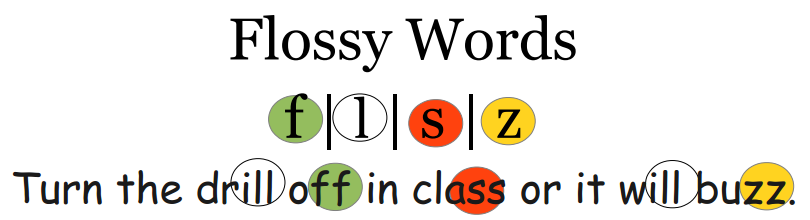
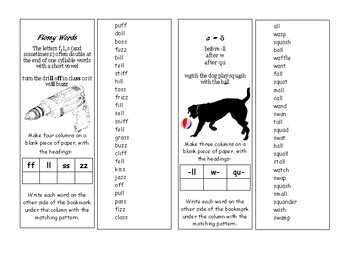
Flossy Words. The letters f, l, s (and sometimes z) often double at the end of one syllable words with a short vowel. Turn the drill off in class or it will buzz.
The letter a can say short o. The -all word family is special. In these flossy words the letter a makes a short ŏ sound. This can also happen after a w- or after qua-. Watch the dog play squash with the ball.
Closed syllables often have a short vowel, but sometimes not. The letters i and o can sometimes be long when followed by two consonants (but not always!) Fīnd and lĭft the lŏst gōld.
Some one syllable words make a schwa sound.Schwa is often a quick and light “uh” sound. Hear the schwa in these sight words: the sled was a lot of fun. And in these words with the letter o: My son won a ton of money a month from the lottery.
Some words with short vowels have consonant digraphs.Digraphs are two letters that make one sound, and these consonant letters together make a new sound.
Download bookmarks with pattern sorts for short vowel variations: flossy words, a can say o, ck endings, and short vowels with digraphs. Word sorts for these patterns are part of the Phonics Pow Toolkit.
The letter y is tricky indeed. It can make many sounds, more than three!
Yes, y is a consonant in yellow and yolk.
Sometimes y makes a short i sound like in system and gym.
A y at the end can a vowel be, with the sound of a long i or e. How do you know which you see? At the end of one syllable words, y often says “i” like in fly. With more syllables, it is often a long e.
There are some exceptions, like the one syllable word “key” with the long e sound. (Hey! No Way! -ey can sound like a long a in some words like grey, and the vowel team -ay a long a will say.) You can’t deny y is long i in two syllable words like: July, supply, reply, rely, and apply. Some two syllable words go in the long i pile like typist and style.
WATCH videos and PLAY online games about Tricky y at the Vowels That Vary Wakelet tutorial.
After learning about Consonant Digraphs with short vowels at the end of the SOUND OUT WORDS section (II.c), and about Bossy R (III.b), it is time to learn about words that have BOTH! Words like…
SHARK CHART
I was inspired by Shark Week to put together a free set of activities that includes a worksheet, a word search, and a word sort. The words can be sorted two ways: by digraphs or by the Bossy R vowel. The SHARK CHART freebie is available to download at the Super Tutor Tools store at Teachers Pay Teachers. Also available is a free wordlist and set of bookmarks with consonant digraphs and vowel patterns.
When it comes to hands-on games to practice reading skills, a good mix includes Active games, Board games, and Card games. (For free online games for phonics, check out this Symbaloo.) This post contains ideas for each kind of hands-on game.
Alphabet
A. Fishing for letters (kidergartencrayons) Match on Bubble Letters (pdf) mat and cover with glass gems. (free from Super Tutor Tools)
A. word roll: Make letter dice with a template from atozteacherstuff. Set a timer & roll to make the most real words. Or CVC pancake flip (turnstall’s teaching tidbits)
A. Word family toss (icanteachmychild) or roll through correct plastic tube into a bucket.
B. Word Family Treasure (free from Super Tutor Tools) Write word family endings onto the game board. Print cards with word families (flyingintolearning) to draw & match with the endings. Get extra treasure for spotting a rhyming pair. Printable treasure coins at Battle For Sight Words from Liz’s Early Learning Spot.
A. Blend target shoot. Write two different blends with dry erase marker on Solo plastic plates. Mix pictures for the two blends (from flyingintolearning below) to draw and throw a suction cup ball to hit the correct target.
A. Pick & Toss – Cut 3 equal size holes in a large box or trifold presentation board. Label the holes AI, EA, & OA. Print Marshmallow Match from thebubblegumtree & cut out the word cards. Take turns drawing a card & tossing a ball or beanbag through the correct hole. 1st one to match & toss all three targets wins.
C. Sight Word Sentence Shake: cut words in columns apart and put into a bottle. Shake a word from each bottle to make a sentence. (free at Super Tutor Tools)
SHORT, LONG, or BOSSY R
After learning about Silent e and Bossy R, click on the wheel below to practice the patterns! Make three columns on the top of a page, with the headings: SHORT, LONG, or BOSSY R. Take turns spinning the wheel to choose a column, then roll dice to choose a word. See who can make the longest list of words in 5 minutes.
Word sorts are a tool for teaching reading skills that have been shown to be effective way for students to learn patterns in words. They are available through Gumroad. You can see the words included at Word Lists.
Online Word Sorts
I have continued to add to my collection of online word sorts made with Flippity. Download the Online Word Sort Index with links to them.
An online word family sort (with short vowels) from Read, Write, Think based on Flash works with the workaround at the End of Flash.
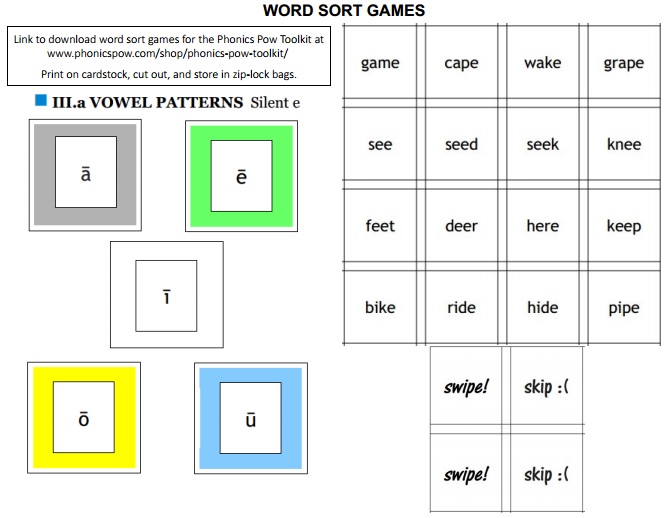
How to play: Choose the word cards for the phonics pattern to practice in sequence. Add cards that skip (the turn is skipped if drawn) or swipe (player can take a word card from the other player) in with the word cards. Each player has a phonogram card, and takes turns drawing a word card and placing it on the correct phonogram. For a quick game, the winner is the player who fills their the phonogram card with one word card of each pattern first. A longer game can be played by using all the word cards, with the winner being the player with the most word cards. POW!
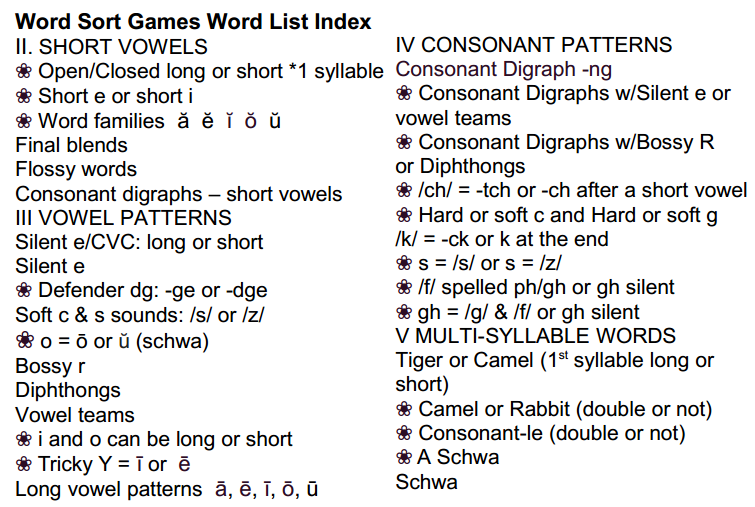
Many of the phonogram cards include color clues. ā is gray, ē is green, ī is white, ō is gold, ū is blue. Below is an index of all the sorts included.
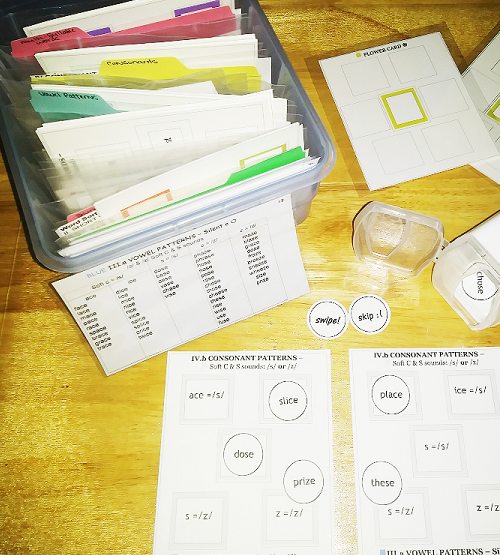
How to set up and organize: Print on cardstock and punch pieces with 1″ circle punch or cut out. Place word sorts in small ziplock bags with labels, and keep in quart ziplock bags with expanding bottoms by sections, or in a Sterlite flip top box. Tabbed index cards are helpful for dividing sections. An empty Extra Refreshers gum container works great for mixing up and drawing the cards.















 Learn about more ways that


 HARK CHART


 Phonics Pow