I seek to create order from the chaos of complex information. Join me at the Daily PlanIt to gain insights, inspiration, and information to increase skills for a better life. I unlock the power of teaching reading with phonics in the pursuit of literacy at www.phonicspow.com. In my spare time I explore books and movies, often choosing titles available on both screen and page.
There are different spellings for the sound of /ul/. A helpful pupil says it is simple: an eagle is a symbol, a squirrel is a mammal. Try a wordsearch and an online word sort at /ul/ variations.
Learning about the different syllable types and the vowel sounds they make is an important skill for decoding – translating letters into words. Hearing syllables in words is also a part of phonological awareness, an essential skill for reading.
In the logical sequence followed by the Phonics Pow Toolkit, the first syllable type learned is closed syllables. When a vowel is closed in by at least one consonant, it often is short. Words with a consonant-vowel-consonant pattern like CAT and DOG (known as CVC words) often have a short vowel. An exception can occur in words with i and o followed by two consonants – see Find and lift the lost gold.
The next syllable type to know about is open syllables. When no consonant follows a vowel, the vowel is often long and says it’s name. Some frequently encountered one syllable words with open and long vowels are: he, she, me, we, be, no, so, go.
Syllables are simple, one for every vowel sound, so there are lots of syllables around. Practice with students to hear how many syllables are in a word. Sort animal flashcards into piles by the number of syllables. You can clap or tap, or feel your mouth drop!
Open and Closed Syllables
WATCH:
When a vowel is followed by at least one consonant, it is closed in. It often makes a short sound, as in pin. (the vowel stops short)
A vowel is open with no consonant behind. Open syllables are often long, you will find. (the vowel can go long)
Advanced phonics patterns are more powerful and follow their own guidelines: “car” makes a new sound because of Bossy R, and so does “loud” because the vowel is a Diphthong. “Cake” and “team” both have long vowel sounds because of Silent e and Vowel Teams. WATCH this video from Jessie Ketchum.
This chart from the Long Vowel Patterns section of the Phonics Pow Toolkit shows some examples of open syllables: a, vacate, he, delete, hi, finite, no, solo, flu, mumu. See the full chart at the post Author Wiley Blevins. Open syllables are found more frequently in words with more than one syllable.
Vowels can vary in the sounds they make. Here are some of the ways that Bossy R words can vary. First let’s look at what happens when words have both a Silent e and a Bossy R.
Silent e vs Bossy R
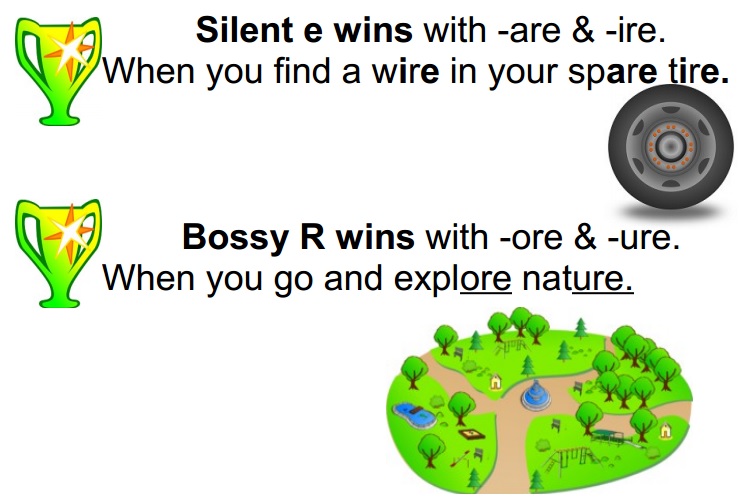
If you find a wire in your spare tire you will see that Silent e wins with -are & -ire. When we explore nature, it is Bossy R that wins with -ore & -ure. Try an online word sort with Silent e vs. Bossy R. A Silent e vs Bossy R words worksheet is available at my Teachers Pay Teachers Super Tutor Tools store.
The Bossy R Schwa
Some words say “er” with different Bossy R spellings. “The pearl is worth a dollar.” In this phrase, all of these spellings make the “er” schwa sound. Try an online Bossy R Schwa word sort.
The -ear phonogram is quite tricky. You will learn (er) not to fear (long e/r) the bear (“air”) with a big heart (ar). WATCH: trigraphs song from english4abc and the ear video from stickyball.net.
The -air sound (or phoneme) can be made with several spellings. Besides the ear in bear, AR can say arrow and ER can say error. Be warned that AR can also say OR when it is warm. IR can say a long e in words like spirit & mirror.
Multiple Meaning Words
When working with Bossy R variations, you may notice that many of these words can be homophones. They sound exactly the same, but are spelled differently and have different meanings. “I have a pair of pears.”
You may also see homonyms or homographs, words that are spelled and sound the same but have different meanings. “I will park the car at the park.” In the phrase “There is a tear in my eye as I tear up the paper” the word tear is a hetronym. Hetronyms are a type of homograph that have the same spelling, but a different sound and meaning.
READ “A Bat Cannot Bat, a Stair cannot Stare” by Brian P Cleary, “Dear Deer” by Gene Barretta, “Eight Ate” and “The Dove Dove” by Marvin Terban.
Practice Schwa Bossy R with worksheets that can also be used as word sorts available at the Super Tutor Tools store at Teachers Pay Teachers. A free copy of the Multiple Meaning Chart can be found there as well. PLAY a homophone Search-a-word puzzle.
Vowels can be long with the Silent e pattern, Vowel Teams, Open Syllables, and Tricky Y. See Long Vowel Patterns. Two more important long vowel patterns to learn are: i and o can be long when followed by two consonants, and open syllables in two syllable words with one middle consonant. These can be challenging, because in both cases, words may have either the long or short sound.
The first syllable in two syllable words with one middle consonant can be either long or short, so it is important to understand and practice these words too. Since more are long (60%) than short (40%), try the long vowel sound first to see if it is a recognizable word. If it is not, try it with the short vowel sound.
One of the trickiest things about the English language is that vowels may sometimes look the same and make different sounds. There are even variations with short vowels. (II.b)
Y at the end of a one syllable word, often says a long “I” as in fly. Learn more about Tricky Y.
We have met OO/OO, one of the diphthongs. Which might be a foot that is short, or a boot that is too long. How about OU, which can be very rough? More than six sounds can really be tough. i before e is weird too and can vary a lot. i before e, unless foreign scientist Keith leisurely seizes caffeine from feisty atheists.
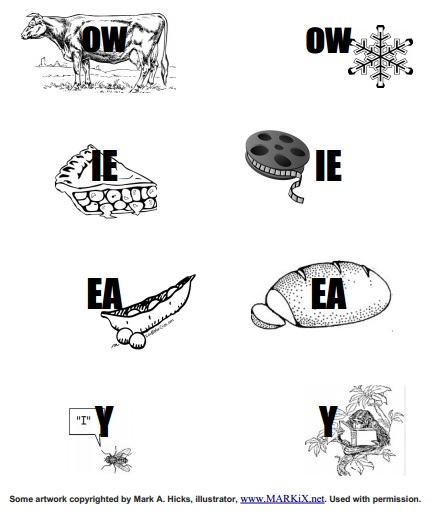
More vowels that can vary are OW, EA, IE. When you eat (ē) bread (ĕ ) with a steak (ā) , EA can also say a long a, isn’t that great?
R controlled vowels can vary a lot: AR can sound like ER, as in pillar or dollar. So can OR, when you start your motor. When there is an E before AR all bets are off. It might be ER when you learn, or maybe a long e that you hear. It can even be a polar bear on a chair. Learn more about the Bossy R Schwa sound and other variations.
Last, but not least of all, is the amazing schwa. Any vowel can make this lazy (often) “uh” sound, so watch out for schwas all around!
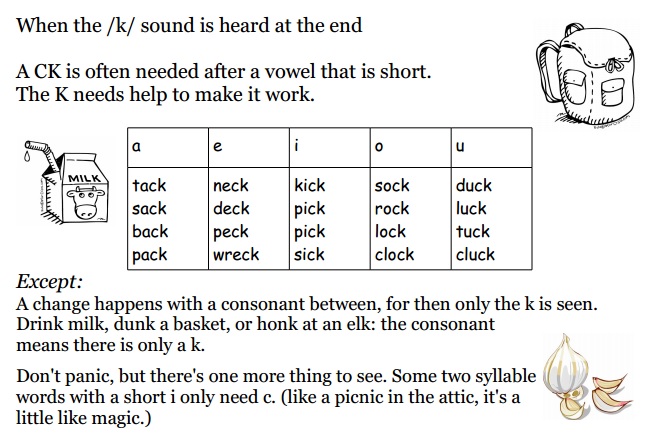
A CK is often needed after a vowel that is short. The K needs help to make it work.
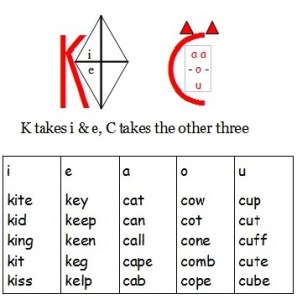
PLAY PRINTABLES Consonant Variations Soccer Sort Games include Hard and Soft C and G, and K or CK ending, available at the Super Tutor Tools store at Teachers Pay Teachers.
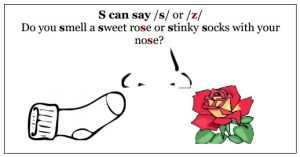
Sounds of S: letter S can also make more than one sound. S can say snake, probably everyone knows. It can also say /z/ when a nose smells a rose. Of course in the faces of horses the sound is /iz/. A free word sort game for the letter S is available at the Super Tutor Tools store at Teachers Pay Teachers.
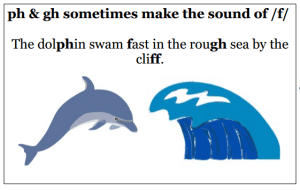
The sound of /f/ can be spelled many ways indeed, more than three! In the following sentence, how many ways do you see? The dolphin swam fast by in the rough sea by the cliff. (f as in fast, ff as in cliff, ph as in dolphin, and gh as in rough.)
Digraphs are a pair of letters representing one sound. The consonant digraphs that make new sounds are CH, SH, TH, WH + NG.
Consonant Digraphs may be introduced after learning about Blends, using words with short vowels. Many words with consonant digraphs have more advanced vowel patterns, which can be introduced as the patterns are learned. Download a free Consonant Digraph Word List with Bookmarks at the Super Tutor Tools store at Teachers Pay Teachers. Practice words with short vowels and a consonant digraph with an online wordsearch.
Elvis Presley was known as the King of Rock & Roll. He liked to wear rings when he sang. His longest song was “Suspicious Minds” (7:14) On Nov. 1, 1969, it reached number one on Billboard’s Hot 100.
In some words, the consonant digraph th makes a vibration or voiced sound. At the beginning of words: this, that, them, than, then. In the middle of words: father, mother, brother. At the end of some verbs: smooth, bathe, breathe.
In other words, the th is a quieter or voiceless sound. At the beginning of words: thin, thick, thud, thumb. Or at the end of words: bath, math, with, cloth. In the middle of some words: ethics, method, lethal.
READ the Pattern – Digraph Sentences from stickyball.net. READ Books: by author Brian Cleary: “Whose Shoes Would You Choose?” “The Thing on the Wing Can Sing” and “Spring in the Kingdom of Ying”
CK = /k/ at the end of one syllable words with short vowels like duck.
PH = /f/ in some words like phone. Learn more at Fall for Phonics.
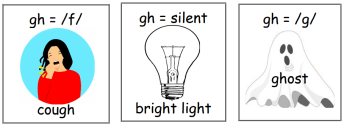
GH can vary. GH = /f/ as in laugh, or /g/ as in ghost. Sometimes the letters GH are silent as in light. The letters GH are enough /f/ to make you sigh (silent), aren’t they just ghastly /g/? Learn more at a Ghost With a Slight Cough Gave a Great Fright.
-tch ending
The /ch/ sound immediately after a short vowel in a one syllable word is often spelled with -tch. Learn more at Catch the Pitch.
Some words have both a Silent e vowel and a consonant digraph. Practice these with activities at Chase the Sheep. Some words have both a Bossy R vowel and consonant digraphs. Practice these with activities at Shark Chart. Some words have both a vowel combination (diphthong or vowel team) and consonant digraphs. Practice these with activities at Smooth Beach.
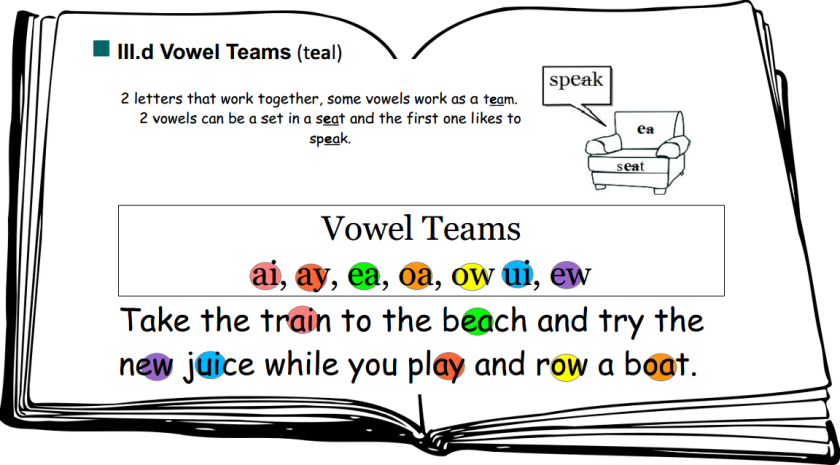
Two letters that work together, some vowels work as a team. Two vowels can be a set in a seat and the first one likes to speak.
Digraphs are two letters that work together to make one sound. Vowel Digraphs can make new sounds like the Diphthongs. After learning Diphthongs, the remaining Vowel Teams are often long, making the sound of the 1st vowel & the 2nd vowel is silent. This guideline is sometimes not reliable, however. There can be many exceptions. EA often makes the long E sound (eat), but sometimes a short E (bread) or long A (steak). IE often makes the long I sound, but sometimes a long E sound (pie or thief).
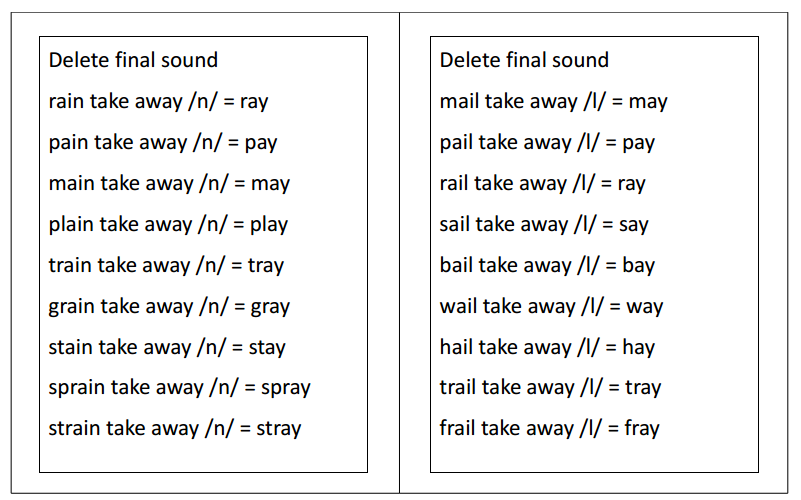
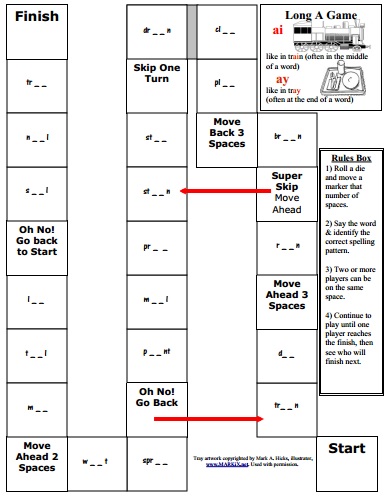
AY is often used at the end of a word or syllable, AI at the beginning or middle of a word or syllable. Practice this with the phonemic awareness activity above, an online word sort, and a wordsearch.
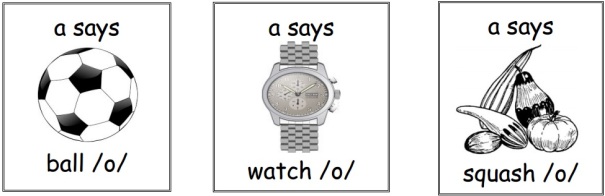
When two letters work together to make one vowel sound that is new, they may be called Diphthongs. These vowel combinations are not long or short (mostly), but make completely different vowel sounds. The letters OI and OY make the same sound. OU and OW do too sometimes, although they can make other sounds. These vowel combinations make sounds with mouth positions that change, the definition of a diphthong. The letters AU and AW make the same sound as a short o. The letters OO can make two different sounds: a short oo like in “foot” or a sound like a long u in “boot.”
Digraphs are two letters that make one sound, and diphthongs may be called vowel digraphs. Vowel teams that often make a long vowel sound are also vowel digraphs, so it is helpful to learn these separately. When Diphthongs are learned first, many of the remaining vowel combinations are long, although this is not always true and there are many variations to learn.
Exceptions: OW can also make a Long O sound in some words (like know and blow). Oh, Those OUGH Words explores some of the variations of OU. It can say OR like in pour, or OO like in soup, and different sounds when followed by the letters ld or gh.
Some words with Bossy R vowels also have a consonant digraph. Practice these words with activities at Shark Chart!
Bossy R Variations
Bossy R can vary sometimes. When Bossy R meets Silent e, Silent e wins sometimes: words with -are can say long a, Examples: care, share, flare. -ire can say long i, Examples: fire, tire, wire. But notice that OR wins: adore, bore, shore, snore & UR wins: nature, picture, treasure.
An e before ar can have many different sounds: long e (hear), “er”(learn), “air” (pear), & “ar” (heart)
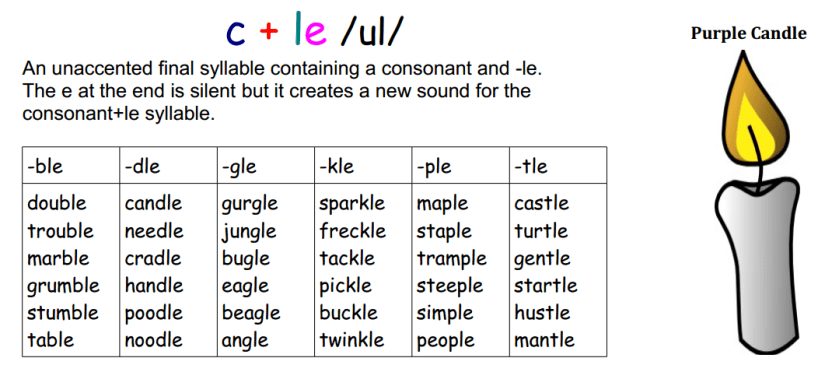 Consonant -le is the last syllable type learned about in the sequence followed by the Phonics Pow Toolkit. Learning the different syllable types helps makes sense of the different vowel sounds in the English language. We’ve learned about: Silent e, Bossy R, Diphthongs, Vowel Teams, and Open & Closed Syllables. Now it’s time for a final stable syllable ending, consonant -le.




















 Phonics Pow